
Step-by-Step: Building a Gordon Growth Model in Excel
To calculate the intrinsic value of a company, follow these steps to set up your spreadsheet:
1. Set Up Your Inputs
Create a small table in Excel with the following three variables:
--- Next Year's Expected Dividend (D1): This is the cash payout per share expected in the next 12 months.
---Cost of Equity (r): Your required rate of return. For the NOK example, we used 8.0%.
---Constant Growth Rate (g): The rate at which the company will grow its dividends forever. For NOK, we used 2.0%
2. Enter the "Magic" Formula
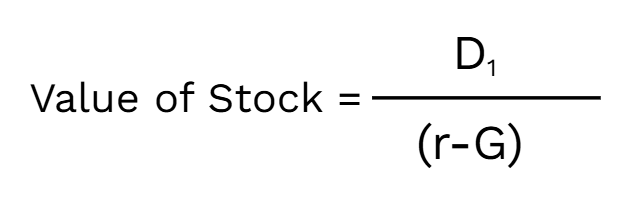
In a new cell, apply the GGM formula:
= D1 / (r - g)
Important Rule: Your Cost of Equity (r) must be greater than your Growth Rate (g) for the math to work. If g is higher than r, the formula will return a negative number, which is impossible for a stock price!
3. Example Calculation (The NOK Case)
If we look at the historical valuation of Nishiyama Onsen Keiunkan (NOK) starting in 705 AD:
Expected Dividend (D_1): 1.020
Cost of Equity (r): 0.08
Growth Rate (g): 0.02
Excel Calculation: = 1.02 / (0.08 - 0.02)
Resulting Value: 17.0
Why This Works for Long-Term Investors
As Myron J. Gordon discovered, this works because it sums an "infinite geometric progression".
The Dividend Stream: When you buy a stock, you are buying the right to all future dividends.
The Simplified Exit: Even if you plan to sell the stock at a future "Price1," that price is just the sum of all dividends from that point forward.
The Convergence: Over a long enough time (like NOK’s 1,321 years), the discounted value of those far-off dividends eventually converges to a single, finite number.
Curious what the Gordon Growth Model is, how it works, when to use it, and how future dividends translate into today’s stock value?
Recommended resource: Read https://valuationmasterclass.com/gordon-growth-model-explained
Your Next Step
VALUATION MASTER CLASS BOOT CAMP STARTS FEB. 16, 2026
Still a student? A limited, application-based student rate is available → Click here to learn more.