
WACC: The "Hurdle Rate" Every Student & Pro Needs to Master
Want to Avoid the Most Common Valuation Mistakes?
Download '9 Valuation Mistakes & How to Avoid Them' book and learn how professional analysts think about EBITDA, multiples, and real-world valuation decisions.
Whether you are preparing for a CFA exam or preparing a pitchbook for a client, one acronym rules them all: WACC.
At its simplest, WACC (Weighted Average Cost of Capital) is the average rate a company pays to finance its assets. Think of it as the "price" of the money a company uses to grow.
If a business doesn’t earn more than its WACC, it isn't creating value—it's essentially a car burning more fuel than it has in the tank.
Why Students and Professionals Both Care About WACC
For Students:
WACC is the ‘core’ of the DCF (Discounted Cash Flow) model. It is the number you use to bring future millions back to today’s dollars.
For Professionals:
It is the "hurdle rate."
Managers use it to decide if a new project or acquisition is worth the risk.
The Two Sources of "Fuel": Equity and Debt
Every company finances its operations using a mix of debt and equity, and neither source is free.
1. Debt (The Loan)
Money borrowed from banks or bondholders. Debt is generally cheaper because lenders are paid first and interest is tax-deductible.
2. Equity (The Ownership)
Capital from shareholders. Equity is more expensive because shareholders take more risk and expect higher returns.
How to Calculate WACC (Simple 3-Step Method)
To find the WACC, you essentially average the cost of these two sources based on their "weight" in the company's capital structure.
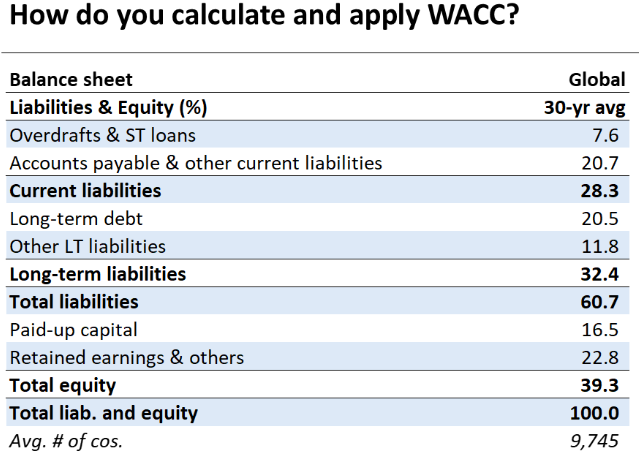
1. Find the Weights: What percentage of the business is Debt vs. Equity?
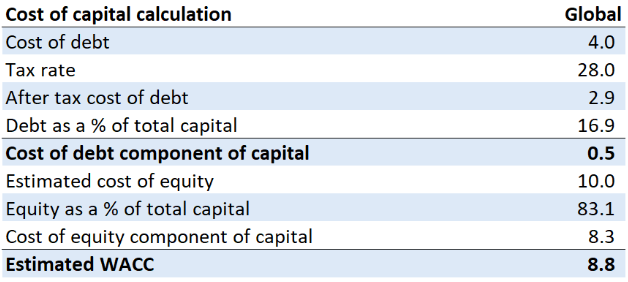
2. Calculate the Costs: Use the interest rate for Debt (adjusted for taxes) and the CAPM model for Equity.
3. The Weighted Average: Multiply the costs by their weights and add them together.
Applying WACC in Practice
WACC is used across valuation, investment analysis, and capital budgeting. It helps determine whether a company is creating value and guides decision-making at both the student and professional level.
Conclusion: Value > Profit
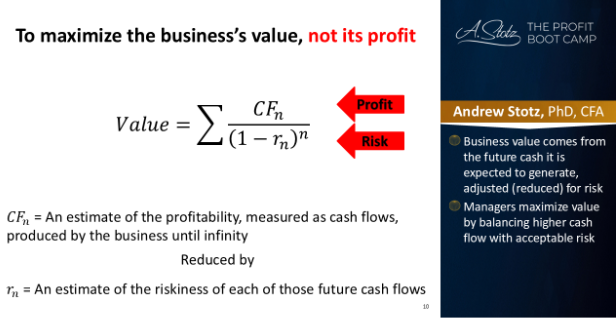
As emphasized by Dr. Andrew Stotz, the objective of a business is to maximize value, not simply increase profit.
For students, mastering WACC is a critical step toward thinking like a CFO. For professionals, it remains one of the most important benchmarks in financial decision-making.
Build Your Valuation Expertise
Understanding and applying WACC is fundamental to business valuation.
To deepen your valuation skills and build a practical proof in just 12 weeks, join the Valuation Master Class Boot Camp.
VALUATION MASTER CLASS BOOT CAMP STARTS FEB. 16, 2026
Still a student? A limited, application-based student rate is available → Click here to learn more.